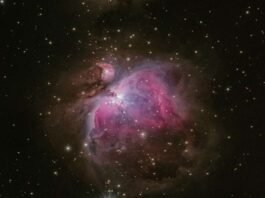
Look up at the night sky. Every star, galaxy, and nebula you can see — and everything detected by our most powerful telescopes — makes up just 5% of the universe. The remaining 95% is invisible: 27% is dark matter, 68% is dark energy. Together, they shape the structure of everything — and we have no idea what they are.
What Is Dark Matter?
Dark matter is matter that does not emit, absorb, or reflect light — making it completely invisible to every telescope ever built, regardless of wavelength. We cannot see it. We cannot detect it directly with any instrument we currently have. And yet we are certain it exists, because its gravitational effects on visible matter are unmistakable.
The Evidence for Dark Matter
Galaxy Rotation Curves
In the 1970s, astronomer Vera Rubin measured how fast stars orbit the centres of spiral galaxies. Based on the visible mass (stars and gas), stars far from the galactic centre should orbit more slowly — just as outer planets in our solar system move more slowly than inner ones. Instead, she found that stars at the edges of galaxies orbit at roughly the same speed as those near the centre — or even faster.
The only explanation was that galaxies are embedded in a vast halo of invisible mass that extends far beyond their visible edges and provides the extra gravitational pull. The amount of this unseen matter is 5–6 times the visible mass of the galaxy.
Source: Rubin, Ford & Thonnard, Astrophysical Journal (1980)
Gravitational Lensing
Einstein’s general relativity predicts that mass bends the path of light. Massive galaxy clusters bend the light of objects behind them, acting as cosmic lenses. The degree of lensing observed consistently requires far more mass than the visible galaxies contain — again pointing to invisible matter.
The Bullet Cluster
The most compelling single piece of evidence comes from the Bullet Cluster — two galaxy clusters that collided about 150 million years ago. When they collided, the visible matter (hot gas) slowed and clumped together due to electromagnetic interactions. But the dark matter — detected through gravitational lensing — passed straight through the collision with minimal interaction, because dark matter only interacts gravitationally. This is exactly what dark matter theory predicts.
Source: Clowe et al., Astrophysical Journal Letters (2006)
Cosmic Structure
The large-scale structure of the universe — the web of galaxy filaments and voids — matches computer simulations only when dark matter is included. Without it, galaxies would not have had enough gravitational glue to form from the smooth early universe in the time available.
What Could Dark Matter Be?
We know what dark matter is not: it is not ordinary atoms, not black holes (in sufficient quantities), not neutrinos (which are too light and fast). The leading candidates:
- WIMPs (Weakly Interacting Massive Particles): Hypothetical particles that interact only via gravity and the weak nuclear force. They emerge naturally from supersymmetry theory. Decades of searching by detectors like LUX-ZEPLIN have not found them — but the search continues.
- Axions: Extremely light hypothetical particles originally proposed to solve a different problem in particle physics. Experiments like ADMX are hunting for them using powerful magnetic fields.
- Primordial Black Holes: Black holes formed in the early universe. Gravitational wave detectors have constrained but not ruled out their contribution.
- Sterile Neutrinos: A hypothetical fourth type of neutrino that interacts only gravitationally.
Could General Relativity Be Wrong?
An alternative view — Modified Newtonian Dynamics (MOND) and related theories — suggests that rather than dark matter existing, gravity itself behaves differently at low accelerations. These theories explain galaxy rotation curves well but struggle to account for all the evidence, particularly the Bullet Cluster. Most physicists consider dark matter more likely to exist than modified gravity, but the debate continues.
Why Does It Matter?
Dark matter is not an obscure academic puzzle. It shaped every galaxy, every star, every planet — and ultimately every living thing. Understanding what it is would be one of the most profound discoveries in the history of science, with implications for particle physics, cosmology, and potentially technology we cannot yet imagine.
The universe is hiding something from us. We just have not figured out where to look.