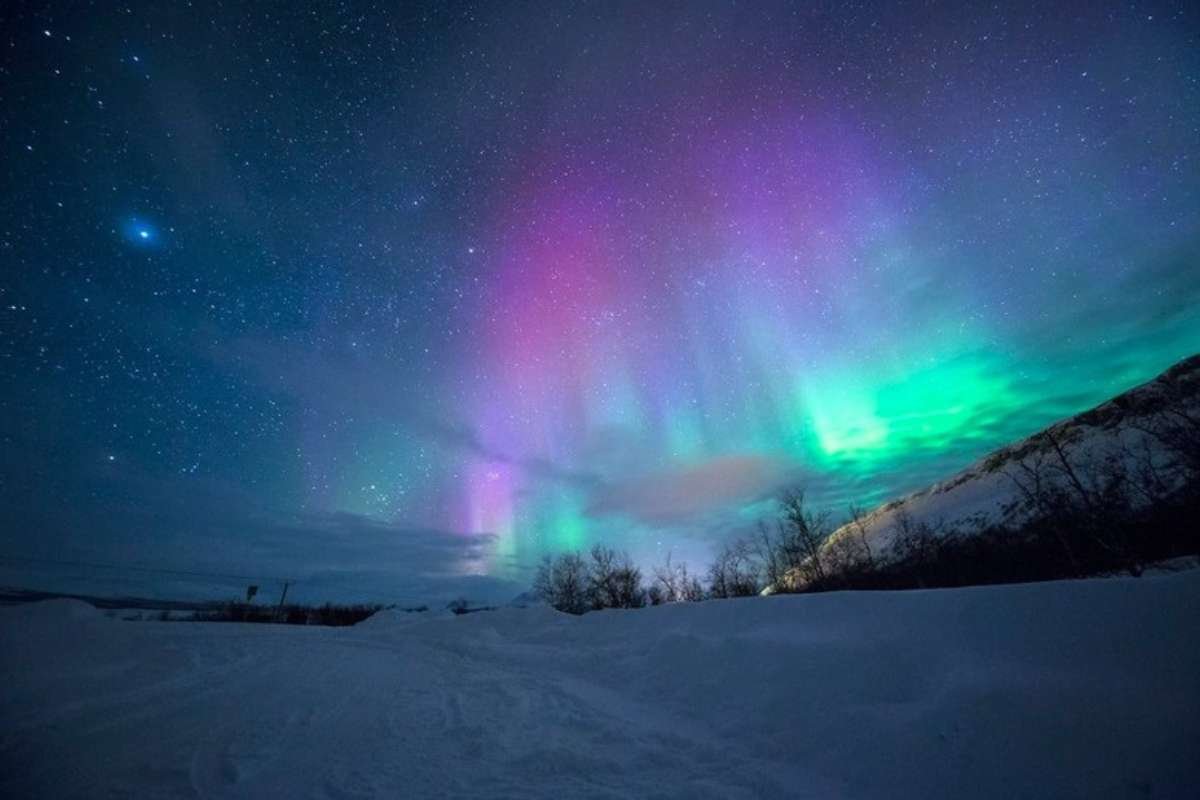
The northern lights — aurora borealis — rank among the most spectacular natural phenomena on Earth: shimmering curtains of green, purple, red, and white light dancing across the night sky. They have inspired myths, legends, and pilgrimages for millennia. The science behind them is equally extraordinary.
It Starts at the Sun
The auroras are caused by the Sun — specifically by charged particles (mainly electrons and protons) that stream outward from the Sun in what is called the solar wind. The solar wind travels at 400–800 kilometres per second and constantly bathes the Earth.
The Sun also periodically releases enormous bursts of plasma called coronal mass ejections (CMEs), which can cause much more intense auroral displays when they reach Earth 1–3 days after the eruption.
Source: NASA — The Sun
Earth’s Magnetic Field — The Deflector
Earth is protected from the constant bombardment of the solar wind by its magnetosphere — a vast magnetic bubble generated by the movement of liquid iron in Earth’s outer core. Most solar wind particles are deflected around Earth by the magnetosphere.
But at the polar regions, Earth’s magnetic field lines converge and dip toward the surface. Here, charged particles can spiral down along the field lines and enter the upper atmosphere — concentrated in oval-shaped regions around the magnetic poles called auroral ovals.
The Light Show: Atmospheric Collisions
When the incoming charged particles collide with gas molecules in the upper atmosphere (at altitudes of 100–300 kilometres), they excite the atoms — transferring energy that causes electrons to jump to higher energy levels. When those electrons drop back to their ground state, they release that energy as photons of light.
Different gases at different altitudes produce different colours:
- Green (most common): Oxygen at ~100–150km altitude
- Red (rarer, high altitude): Oxygen at ~200–300km altitude
- Blue and purple: Nitrogen molecules
- Pink/magenta: A mix of nitrogen blue and oxygen green at lower altitudes
The Solar Cycle and Solar Maximum
The Sun’s activity follows an approximately 11-year cycle, swinging between solar minimum (fewer sunspots and CMEs) and solar maximum (intense activity). We are currently in Solar Cycle 25, which reached its predicted maximum around 2024–2025 — meaning auroral activity has been elevated, with displays visible much further from the poles than usual.
In May 2024, a powerful geomagnetic storm (G5 — the strongest in 20 years) produced northern lights visible as far south as Florida, Texas, and southern Europe.
Source: NOAA Space Weather Prediction Center
The Southern Lights
The same phenomenon occurs at the South Pole — the aurora australis, or southern lights. They are equally spectacular but less visited simply because the land mass around the South Pole (Antarctica) is far less accessible than the inhabited Arctic regions.
Where and When to See the Northern Lights
The best locations are within or near the auroral oval: northern Norway (Tromsø), Iceland, northern Finland, Alaska, northern Canada, and Siberia. The further north (or south), the more frequently they appear.
Key conditions:
- Dark skies: New moon periods, away from light pollution
- Clear skies: Clouds block the view
- Solar activity: Check the Space Weather Live Kp index — Kp 5+ usually means visible auroras at mid-latitudes
- Time of year: Around the equinoxes (March and September) tend to produce more geomagnetic activity
Can Auroras Be Predicted?
Yes — with increasing accuracy. NOAA’s Space Weather Prediction Center issues aurora forecasts based on solar wind data from the DSCOVR satellite, positioned at the L1 Lagrange point between Earth and Sun. It gives roughly 15–60 minutes advance warning of incoming solar wind conditions. Apps like SpaceWeatherLive and Aurora Alert use this data to send real-time notifications.
The northern lights are not magic — but knowing the science does not make standing beneath them any less awe-inspiring.