When the James Webb Space Telescope (JWST) released its first full-colour images in July 2022, it did not just show us the universe — it redefined what was possible in astronomy. Four years on, the discoveries keep coming. Here is a comprehensive breakdown of everything Webb has found and what it means.
What Is the James Webb Space Telescope?
JWST is the most powerful space telescope ever built, a joint project between NASA, the European Space Agency (ESA), and the Canadian Space Agency (CSA). It observes the universe primarily in infrared light, allowing it to see through dust clouds that blocked the Hubble Space Telescope’s view, and to observe objects so far away that their light has been stretched from ultraviolet into infrared over billions of years of travel.
Webb orbits the Sun at the second Lagrange point (L2) — about 1.5 million kilometres from Earth — where it remains in stable alignment with Earth and Sun. Its mirror spans 6.5 metres across, composed of 18 hexagonal gold-coated beryllium segments, giving it roughly 6.25 times the light-collecting area of Hubble.
Source: NASA JWST Mission Overview
The Earliest Galaxies Ever Seen
One of Webb’s most headline-grabbing achievements has been observing galaxies that formed just 200–400 million years after the Big Bang — far earlier than anyone expected to find such developed structures.
In 2022, Webb identified galaxy GLASS-z13, existing just 300 million years after the Big Bang. In 2023, it went further, confirming galaxies including JADES-GS-z14-0 at a redshift of z=14.32 — the most distant confirmed galaxy ever observed, from just 290 million years after the Big Bang.
These early galaxies were larger and more developed than theoretical models predicted, forcing cosmologists to revise their understanding of how quickly galaxies form after the Big Bang.
Source: Nature — JADES survey (2023)
Atmospheres of Exoplanets
Webb is revolutionising exoplanet science. In 2022, it produced the most detailed atmospheric analysis ever of an exoplanet — WASP-39b — detecting carbon dioxide, sulphur dioxide, water, and sodium. This was the first clear detection of CO₂ in an exoplanet atmosphere.
In 2023, Webb examined K2-18b, a “Hycean” world (potentially ocean-covered with a hydrogen atmosphere), and found a tentative signal of dimethyl sulphide (DMS) — a molecule that on Earth is only produced by living organisms. The finding was cautiously reported and requires further confirmation, but it remains one of the most tantalising biosignature hints ever detected.
Source: Nature Astronomy — K2-18b (2023)
Stellar Nurseries in Unprecedented Detail
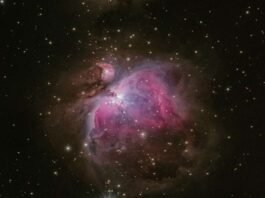
Webb’s infrared vision allows it to peer into stellar nurseries — dense clouds of gas and dust where stars are being born — in extraordinary detail. The Carina Nebula and Orion Nebula images revealed hundreds of previously unseen protostars and planetary discs forming around young stars, providing direct evidence of how solar systems like ours form.
Rewriting Our Understanding of the Early Universe
The so-called “Hubble Tension” — a longstanding disagreement between different measurements of how fast the universe is expanding — has been a headache for cosmologists for years. Webb’s precise distance measurements of stars known as Cepheid variables have confirmed the tension is real and not the result of measurement error, deepening the mystery and potentially pointing to new physics beyond the standard cosmological model.
Source: Astrophysical Journal Letters — Hubble Tension (2023)
Our Own Solar System
Webb also turns its gaze closer to home. It has produced the sharpest infrared images ever of Neptune’s rings, revealed previously unknown rings around Uranus, captured seasonal changes in Mars’ atmosphere, and detected complex organic chemistry in the clouds of Jupiter.
What Comes Next?
Webb is expected to operate for at least 20 years — it had an exceptionally precise launch that used far less fuel than the worst-case scenario, extending its operational lifetime significantly. Upcoming targets include deeper surveys of early galaxies, more exoplanet atmospheres (including TRAPPIST-1 system planets in the habitable zone), and studies of dark matter distribution in galaxy clusters.
The telescope that has already rewritten astronomy has barely begun.