
It is one of the first questions children ask and one that stumped philosophers for centuries. Why is the sky blue? The answer involves the nature of light, the physics of scattering, and the composition of Earth’s atmosphere — and it is more elegant than you might expect.
First: What Is Light?
Visible light is a form of electromagnetic radiation — energy travelling in waves. White sunlight is actually a mixture of all the colours of the rainbow, each with a different wavelength. Violet and blue light have the shortest wavelengths (around 380–450 nanometres); red light has the longest (around 620–750nm).
What Happens When Light Enters the Atmosphere?
Earth’s atmosphere is mostly nitrogen (78%) and oxygen (21%) — tiny molecules far smaller than the wavelengths of visible light. When sunlight enters the atmosphere, these molecules scatter the light in all directions. But they do not scatter all colours equally.
The amount of scattering depends strongly on wavelength. Shorter wavelengths (blue and violet) are scattered much more than longer wavelengths (red and orange). Specifically, blue light is scattered about 5.5 times more than red light.
This phenomenon is called Rayleigh scattering, named after Lord Rayleigh (John William Strutt), who described it mathematically in 1871.
Source: Lord Rayleigh, Philosophical Magazine (1871)
So Why Blue and Not Violet?
Here is where it gets interesting. Violet light actually has an even shorter wavelength than blue and is scattered even more. So why isn’t the sky violet?
Several reasons:
- The Sun emits less violet light than blue light to begin with
- Our eyes have three types of colour receptors (cones). They are less sensitive to violet than to blue
- Some violet light is absorbed in the upper atmosphere
The combination of all these factors means our eyes perceive the scattered light as blue rather than violet.
Why Are Sunsets Red and Orange?
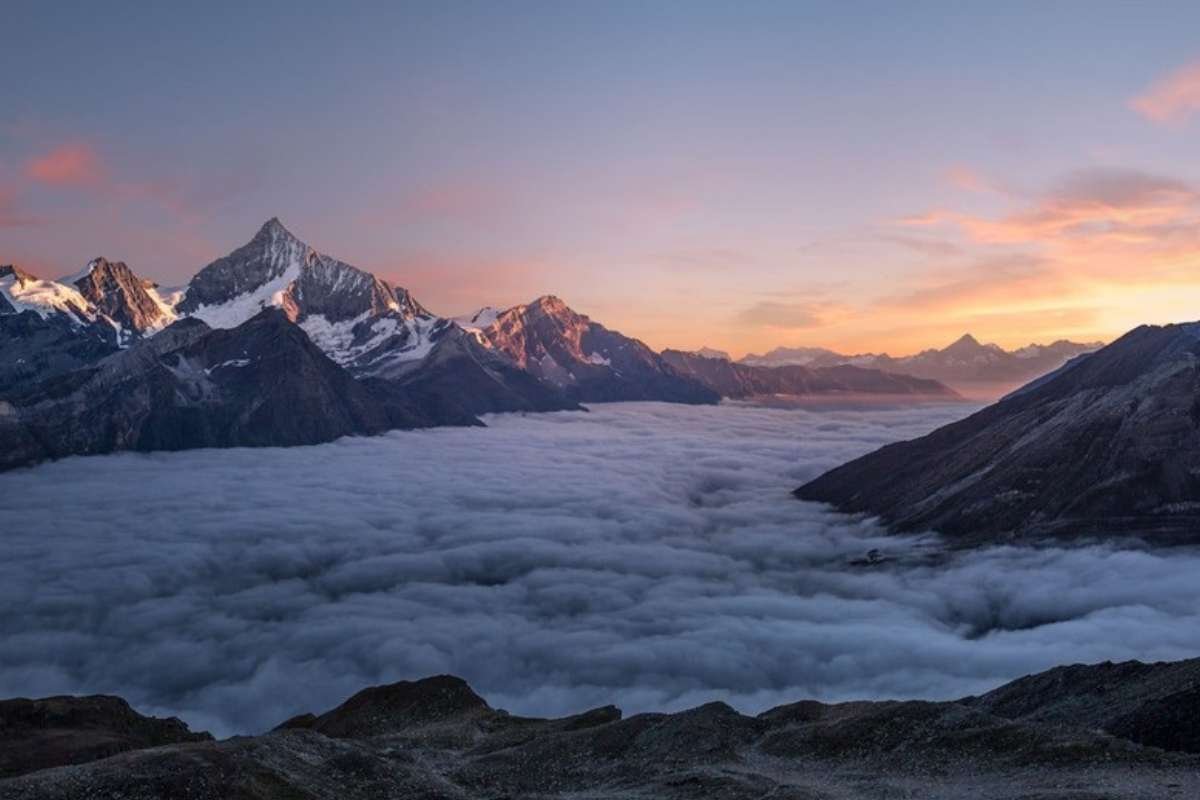
At sunrise and sunset, sunlight travels through a much longer path of atmosphere before reaching your eyes — sometimes 10–40 times longer than when the Sun is directly overhead. By the time it arrives, virtually all the blue light has been scattered away in other directions. What remains is the longer-wavelength red, orange, and yellow light — giving sunsets their warm palette.
Dust, smoke, and pollution can intensify sunset colours by providing additional scattering particles. Volcanic eruptions are famous for producing spectacular sunsets for months afterward as fine ash enters the stratosphere.
Why Is Space Black?
Space has no atmosphere — no molecules to scatter sunlight. Without scattering, light only travels in straight lines from its source. Look directly at the Sun in space and it is blindingly bright. Look anywhere else and there are no scattered photons reaching your eyes — just the blackness of empty space dotted with the direct light of distant stars.
Why Are Clouds White?
Clouds are made of water droplets or ice crystals much larger than atmospheric gas molecules. Large particles scatter all wavelengths of light roughly equally — a process called Mie scattering. Since all colours are scattered equally, the combined result appears white (or grey when the cloud is thick enough to absorb significant light).
Why Is the Ocean Blue?
Two reasons: partly it reflects the blue sky above, but primarily water itself absorbs red, orange, and yellow wavelengths more readily than blue ones. The deeper the water, the more red is absorbed and the bluer it appears. This is also why blood looks green underwater — its red wavelengths have been absorbed before reaching depth.
A simple question — why is the sky blue — opens a window into the physics of light, the structure of our atmosphere, and the biology of human vision. Science rarely disappoints when you pull on the thread.