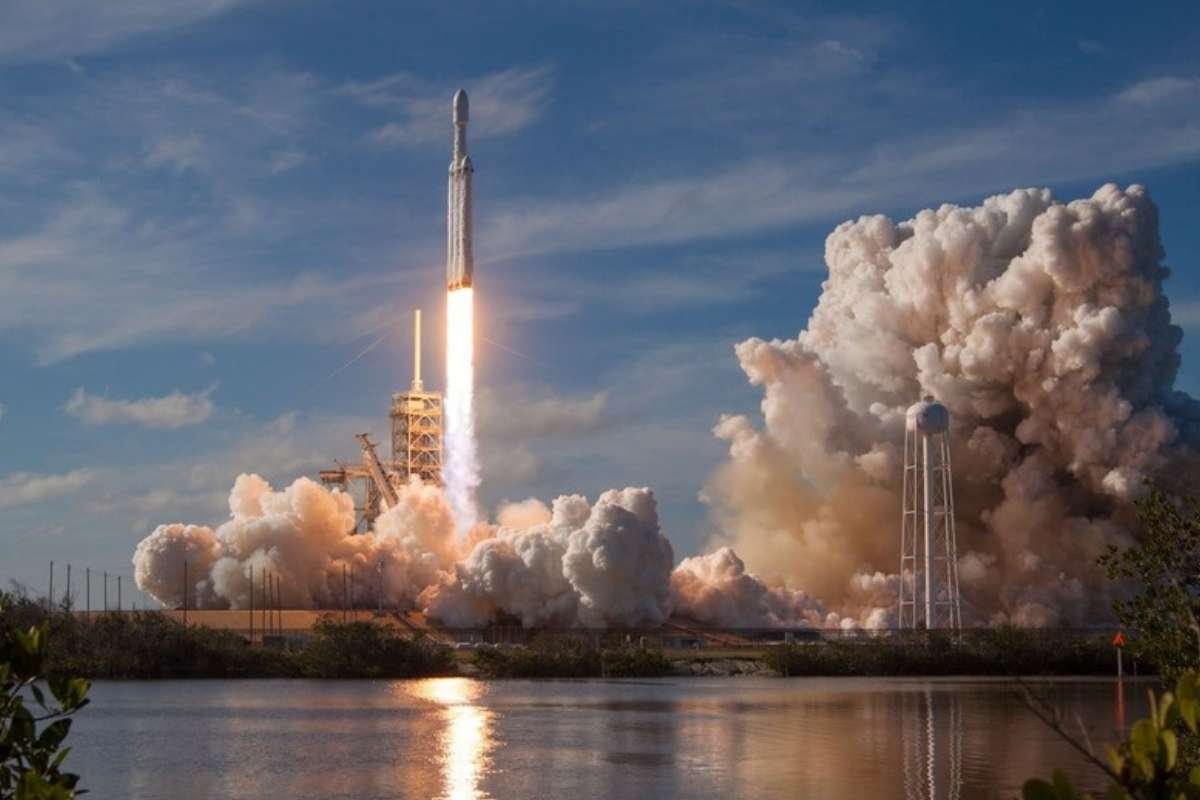
When SpaceX’s Starship lifts off, the ground shakes for miles around. It is the largest and most powerful rocket ever flown — generating nearly twice the thrust of the Saturn V that took humans to the Moon. But raw power is only part of the story. Starship is designed to be something no rocket has ever been: fully and rapidly reusable.
What Is Starship?
Starship is actually two vehicles stacked on top of each other:
- Super Heavy — the first-stage booster, standing 71 metres tall, powered by up to 33 Raptor engines burning liquid methane and liquid oxygen (methalox). It generates approximately 74.3 meganewtons (16.7 million pounds) of thrust at liftoff.
- Starship (the upper stage) — a 50-metre spacecraft powered by 6 Raptor engines, capable of carrying crew, cargo, or satellites. The complete stacked vehicle stands 121 metres tall — taller than the Statue of Liberty at its base.
Source: SpaceX — Starship
What Makes It Different?
Every orbital rocket in history has been expendable — used once and discarded. SpaceX changed that with Falcon 9, landing and reusing its first stage booster. Starship takes this further: both stages are designed to be fully reusable.
Super Heavy returns to the launch site and is caught mid-air by the launch tower’s “chopstick” arms — a system SpaceX calls Mechazilla. Starship re-enters the atmosphere belly-first, protected by ceramic heat shield tiles, then flips upright for a powered landing. The goal is to turn each vehicle around and refly within hours, like an aircraft — dramatically reducing the cost per kilogram to orbit.
The Test Flight History
Starship’s development has been characterised by SpaceX’s “test to failure” philosophy — building rapidly, flying, learning from failures, and iterating:
- April 2023 (IFT-1): First integrated flight test. Vehicle exploded 4 minutes after launch. SpaceX called it a success — the launch pad survived and they gathered data.
- November 2023 (IFT-2): Reached space for the first time. Both stages lost contact shortly after separation.
- March 2024 (IFT-3): First successful reentry of the upper stage. Both vehicles lost during the return phase.
- June 2024 (IFT-4): Both vehicles successfully controlled during reentry. Starship splashed down intact in the Indian Ocean. Super Heavy performed a precise “soft” ocean splashdown.
- October 2024 (IFT-5): Super Heavy booster caught by the Mechazilla chopstick arms — a world first. Starship soft-landed in the Indian Ocean.
Source: FAA — SpaceX Starship
What Is It Designed For?
Starship’s ambitions span multiple missions:
- NASA Artemis Moon landings: NASA selected a modified Starship as the Human Landing System (HLS) to land astronauts on the Moon under the Artemis programme
- Mars colonisation: Elon Musk’s stated goal — a fully reusable, propellant-manufacturable-on-Mars vehicle capable of carrying 100 people and being refuelled in orbit
- Satellite deployment: Can carry over 100 tonnes to low Earth orbit — more than any rocket in history
- Point-to-point Earth travel: Long-term concept for intercontinental travel in under an hour
What About the Environmental Impact?
Each Starship launch produces significant acoustic and exhaust impacts on the surrounding area. SpaceX’s Boca Chica, Texas launch site has been the subject of environmental reviews by the FAA, with concerns raised about impacts on local wildlife refuges and ecosystems. The FAA has required SpaceX to implement environmental mitigations as a condition of launch licences.
Source: FAA Environmental Review
The Bigger Picture
If Starship works as designed, it could reduce the cost of reaching orbit from roughly $2,700/kg (Falcon 9) to under $100/kg — a 27-fold reduction that would fundamentally transform what is economically possible in space. Science missions, commercial stations, lunar bases, and eventually Mars become vastly more affordable.
No rocket in history has attempted what Starship is attempting. Whether it succeeds on Musk’s aggressive timelines or takes decades longer, it has already changed how the aerospace industry thinks about rocket design.