Affiliate Disclosure: The Scientuit may earn a small commission from qualifying purchases made through links in this article, at no extra cost to you.
The Greatest Construction Project in Human History
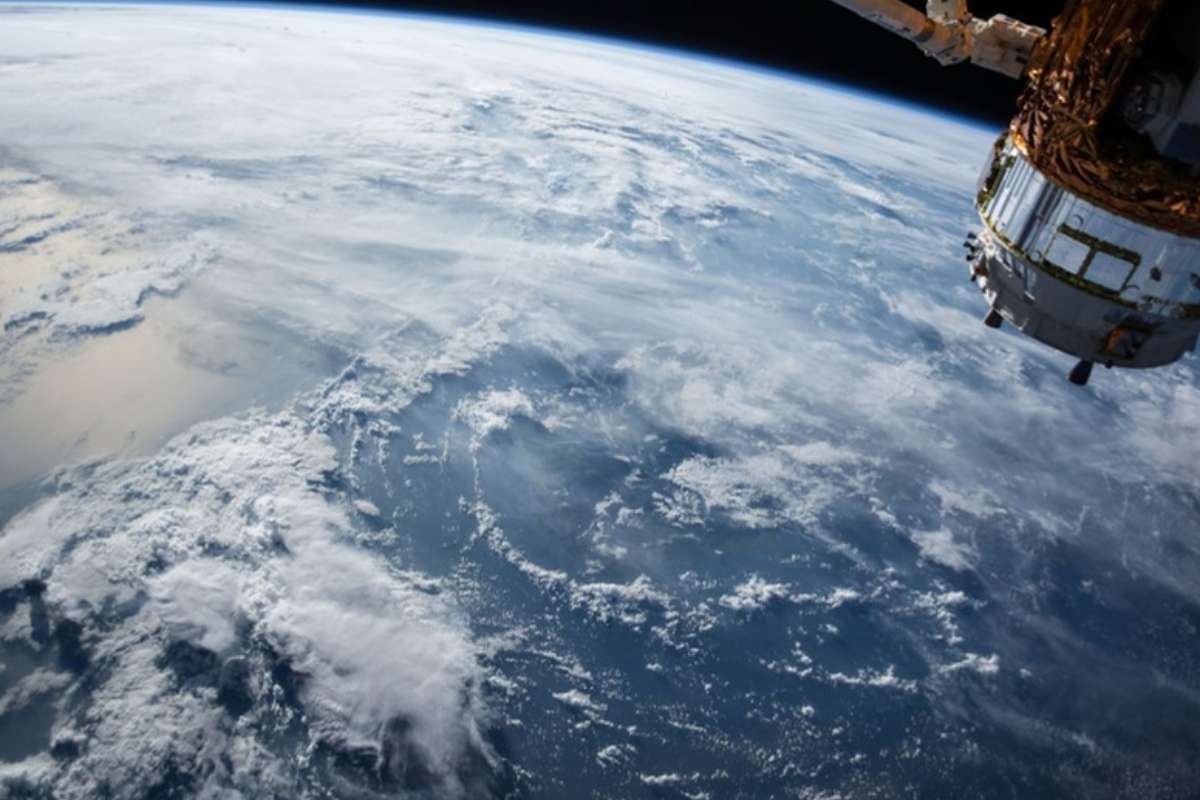
The International Space Station has been continuously inhabited since November 2, 2000 — making it the longest continuously occupied outpost off the surface of the Earth. Every day, human beings wake up, eat breakfast, run experiments, and look out the window at our entire planet below them, in a structure orbiting 400 kilometers above our heads.
We’ve become so accustomed to the ISS that it’s easy to take it for granted. But consider what it actually is: a habitable research laboratory assembled piece by piece in the vacuum of space, built by 15 nations, sustained for over two decades, and still going. Here are ten facts that put the true scale of that achievement into perspective.
1. It’s Roughly the Size of a Football Field
The ISS spans 109 meters from one end to the other — about the length of an American football field including the end zones. Its pressurized living and working volume is equivalent to a six-bedroom house: roughly 388 cubic meters of breathable space. The station’s solar arrays, stretching out on either side, cover more than 2,500 square meters. In terms of mass, the entire structure weighs approximately 420,000 kilograms — about the weight of 320 cars. It was assembled over 13 years, between 1998 and 2011, through more than 40 assembly flights.
2. It Travels at 28,000 Kilometers Per Hour
The ISS orbits Earth at an average altitude of about 408 kilometers, moving at approximately 28,000 kilometers per hour (roughly 7.7 kilometers every second). At that speed, it completes one full orbit of Earth every 90 minutes. To keep up with the station, you’d need to be moving roughly 20 times faster than a commercial airliner. This extraordinary speed is what keeps the station in orbit — it’s essentially in continuous freefall around the Earth, moving so fast horizontally that it keeps missing the planet as it falls toward it. This is also why everything inside feels weightless.
3. Astronauts See 16 Sunrises Every Day
Because the ISS completes 16 orbits per day, the crew experiences 16 sunrises and 16 sunsets in every 24-hour period. The Sun rises every 90 minutes, and the transition from blinding daylight to pitch-black darkness takes just minutes. This plays havoc with the human body’s natural circadian rhythm, which evolved to operate on a 24-hour light-dark cycle. To manage this, the station uses artificial lighting that mimics a 24-hour day, and astronauts follow a strict sleep schedule. Even so, many report that sleep is one of the most challenging aspects of living aboard the station.
4. It Was Built Like a Giant LEGO Set — In Space
The ISS was not launched in a single piece. It was assembled module by module, piece by piece, over 13 years and more than 40 separate launches from multiple countries. The first component — the Russian Zarya module — launched in November 1998. Over the following decade, astronauts conducted 160 spacewalks totaling more than 1,000 hours of extravehicular activity to connect modules, install solar arrays, and attach equipment. Russian Soyuz rockets, NASA Space Shuttles, European Ariane rockets, and Japanese H-II Transfer Vehicles all contributed to building what is, by a large margin, the most expensive structure ever built by human beings — at an estimated cost of over $150 billion.
5. Astronauts Exercise Two Hours Every Day — By Requirement
Weightlessness feels like a superpower, but it does serious damage to the human body. Without gravity constantly loading your bones and muscles, both begin to deteriorate rapidly. Astronauts can lose up to 1–2% of bone density per month in space. To combat this, the ISS crew is required to exercise for two hours every day using specialized equipment, including a treadmill with bungee cords to keep the runner in contact with the surface, a stationary bicycle, and a resistance exercise device that uses vacuum cylinders to simulate free weights. Maintaining physical condition is not optional — it’s a mission-critical activity, directly linked to how well crew members perform and how quickly they recover after returning to Earth.
6. The View Is Unlike Anything on Earth
The ISS is equipped with the Cupola — a seven-windowed observation module added in 2010 that offers a near-360-degree panoramic view of Earth and space. Astronauts describe the experience of looking through the Cupola as one of the most overwhelming moments of their lives. City lights trace coastlines at night. Thunderstorms look like slow-motion fireworks from above. The aurora borealis shimmers in shifting curtains of green and violet. Entire continents slide past in minutes. The atmosphere — the thin blue line that sustains all life on Earth — is visible as an impossibly delicate veil clinging to the planet’s edge. Almost every astronaut who has looked through the Cupola reports a profound shift in perspective about Earth’s beauty and fragility.
7. It Recycles Almost Everything — Including Urine
Resupply missions from Earth are infrequent and enormously expensive, so the ISS is designed to be as self-sufficient as possible when it comes to consumables. The station’s water recovery system collects moisture from the air (including sweat and exhaled breath), filters and purifies it, and returns it to the drinking water supply. Most famously, urine is processed through an advanced distillation system and converted back into clean, drinkable water. NASA estimates that the system recovers about 90–93% of all moisture. As astronaut Don Pettit once memorably said: “Yesterday’s coffee is tomorrow’s coffee.” The system produces water that is, by measurable standards, purer than most tap water on Earth.
8. It’s a World-Class Science Laboratory
The ISS isn’t just a habitat — it’s an active research facility. More than 3,000 scientific experiments from researchers in over 100 countries have been conducted aboard the station. The microgravity environment allows scientists to study phenomena that are impossible to observe on Earth: how fluids behave without convection, how flames burn in the absence of gravity-driven airflow, how proteins crystallize when not deformed by their own weight. Research conducted on the ISS has contributed to advances in cancer treatment, vaccine development, materials science, and our understanding of how the human body ages. The station has also been crucial in developing the medical protocols needed for longer-duration deep space missions.
9. It Has Hosted Astronauts from 20 Countries
The ISS is genuinely international in a way that few human endeavors have ever been. Astronauts and cosmonauts from 20 different nations have lived and worked aboard the station, including the United States, Russia, Japan, Canada, and 11 European countries. For long stretches of the Cold War’s aftermath, the ISS was one of the most active arenas of US-Russian cooperation, with American astronauts launching aboard Russian Soyuz capsules and Russian cosmonauts relying on American systems. At its best, the station embodies what humanity is capable of when nations choose collaboration over competition. The ongoing research partnerships among the 15 partner agencies that manage the ISS represent the largest peaceful international scientific cooperation in history.
10. Its Retirement Is Already Being Planned
Nothing lasts forever — including humanity’s most expensive construction project. NASA has announced plans to deorbit the ISS by January 2031, after more than 30 years of operation. The station will not be abandoned in orbit; instead, it will be carefully guided into a controlled reentry over the South Pacific Ocean, with debris falling into a remote stretch of ocean known as the “spacecraft cemetery” near Point Nemo — the most remote location on Earth. Several private space stations are already in development to replace it, including projects from Axiom Space and Blue Origin. A new era of commercial orbital habitats is on the horizon — but none will have quite the same story as the original.
Further Reading
- An Astronaut’s Guide to Life on Earth by Chris Hadfield — Commander Hadfield spent five months aboard the ISS and became the station’s most famous resident, giving the world a window into daily life in space through his social media posts and that iconic space cover of “Space Oddity.” This book is part memoir, part practical philosophy — full of sharp observations about what it really takes to live and work where no one has lived before. One of the best space books ever written. An Astronaut’s Guide to Life on Earth“>Get it on Amazon