
Few things in science capture the imagination quite like black holes. They are regions of space where gravity is so extreme that nothing — not even light — can escape. They warp space and time, can grow to billions of times the mass of our Sun, and yet we cannot directly see them.
Despite their mysterious reputation, we know a remarkable amount about black holes — and we are learning more every year.
What Is a Black Hole?
A black hole is a region of space where the gravitational pull is so intense that the escape velocity exceeds the speed of light. Since nothing can travel faster than light, nothing that enters a black hole can get back out.
At the centre of every black hole is a singularity — a point (or ring, in rotating black holes) where matter is infinitely dense and our current laws of physics break down. Surrounding the singularity is the event horizon — the point of no return. Cross the event horizon and you are not coming back.
It is worth noting: black holes are not cosmic vacuum cleaners. They do not suck in surrounding matter any more than an ordinary massive object would. If our Sun were somehow replaced by a black hole of equal mass, Earth would continue orbiting in the same path it always has.
How Do Black Holes Form?
Black holes form through several processes:
Stellar Black Holes
When a massive star — at least 20 times the mass of our Sun — reaches the end of its life, it explodes in a supernova. If the remaining core has enough mass (more than about 3 solar masses), it collapses under gravity into a black hole. These are called stellar black holes and typically range from about 5 to 100 solar masses.
Supermassive Black Holes
At the centre of almost every large galaxy — including our own Milky Way — sits a supermassive black hole. These giants contain millions to billions of solar masses. How they formed is still one of the biggest open questions in astrophysics. They may have grown from smaller black holes merging over billions of years, or they may have formed through the direct collapse of enormous gas clouds in the early universe.
Our galaxy’s central black hole, Sagittarius A*, has a mass of about 4 million suns. In 2022, the Event Horizon Telescope collaboration published the first image of it — a glowing ring of hot gas surrounding a dark shadow.
Intermediate and Primordial Black Holes
Scientists also theorise the existence of intermediate black holes (hundreds to thousands of solar masses) and primordial black holes — hypothetical black holes formed in the extreme density of the early universe, fractions of a second after the Big Bang.
Can We See a Black Hole?
Not directly — but we can see their effects. Black holes reveal themselves through:
- Gravitational lensing: Light from objects behind a black hole is bent around it, creating distorted or duplicated images
- Accretion discs: When gas and dust spiral into a black hole, they heat up to millions of degrees and glow brilliantly in X-rays
- Gravitational waves: When two black holes merge, they send ripples through spacetime that can be detected by instruments like LIGO
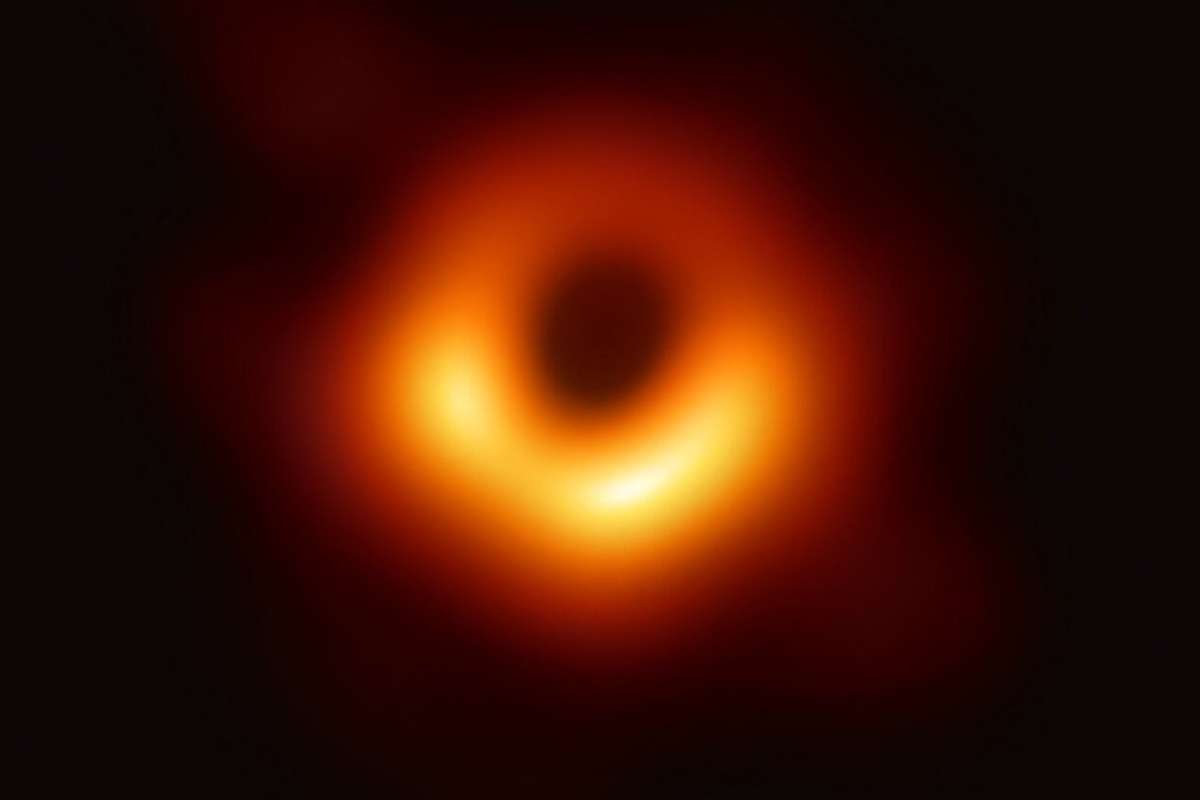
- Event horizon images: In 2019, the Event Horizon Telescope captured the first direct image of a black hole’s shadow — the supermassive black hole M87*, 6.5 billion times the mass of the Sun
What Happens If You Fall Into a Black Hole?
From an outside observer’s perspective, you would appear to slow down as you approached the event horizon, gradually fading and redshifting until you seemed to freeze at the horizon — due to extreme time dilation.
From your own perspective (in a large enough black hole), you might not notice crossing the event horizon at all — at least initially. However, as you fell closer to the singularity, tidal forces would grow extreme enough to spaghettify you — stretching you vertically while compressing you horizontally — long before you reached the centre.
Do Black Holes Ever Die?
Yes — but incredibly slowly. Physicist Stephen Hawking theorised in 1974 that black holes emit a form of thermal radiation (now called Hawking radiation) and gradually lose mass over time. For stellar-mass black holes, the evaporation timescale is so astronomically long — far exceeding the current age of the universe — that it is effectively irrelevant for any practical purpose. But in principle, every black hole will eventually evaporate.
Should We Worry About Black Holes?
No. The nearest known black hole to Earth is Gaia BH1, discovered in 2022, sitting about 1,560 light-years away. It poses absolutely no threat to our solar system. At those distances, black holes are simply fascinating — not dangerous.
The Bottom Line
Black holes are not the terrifying destroyers of science fiction. They are extraordinary natural phenomena — the inevitable fate of massive stars, the anchors of galaxies, and windows into the most extreme physics in the universe. The more we study them, the more we learn about the fundamental nature of space, time, and gravity.